Sunday, July 29, 2007

An odd predicament

A week ago, I was reading the miniscule book review section of The Chronicle and there was a review of a poetry book by Ellen Bass. There are so few reviews of poetry in the local paper, that I usually feel obligated to read them, at least cursorarily. I didn't have much time, as the poetry group was coming and I had much cleaning to do. But though I read the review quickly, my eyes zeroed in on two lines -- quoted not from Bass, but from Mary Oliver: "There is only one question:// how to love this world."

Actually, the review misquoted it as "the" world, but I googled it and found it was from a poem called "Spring". I don't recall ever seeing this poem. It's not, to my mind, very earthshaking, though it's a good enough poem. The thing is, these are exactly two lines that appear in a poem of mine: "Copernican Revolution." Though that poem has gone through many overhauls including the recent addition of a stanza, the original poem, which very much centers around those lines, was from the late eighties. The Oliver poem -- at least the book it was published in -- is from 1992. My poem is unpublished -- though it's in my well-circulated manuscript. I sure don't think Mary Oliver copied those lines from me -- but neither do I remember ever reading that poem or that book or even much Mary Oliver.

So has this ever happened to you? What would you do? Should I remove the poem from my manuscript? Here's the last stanza of "Copernican Revolution":


There’s only one question:
how to love this world, how to find
the will to serve it—
each morning, the new baby skin of light.

Saturday, July 28, 2007

Blogging under the influence ...

I said I would blog this weekend, and here it is, past 7:00 p.m. on Saturday. It was a busy day: John and I took the dog to Pine Lake with the minor detour of neighborhood garage sales. (I bought some lovely linens and crochet doilies and such, the kind of things I had hoped to inherit from my mom, but which disappeared during her final illness. You can't dwell on such things.) Then we went to Sloat Nursery to replace plants that bit the dust during the deck construction. I planted them later. Then we visted the Urban Farmer store so John could get advice and thingies for repairing our garden irrigation -- also mucked up during the deck work, although John believes a gopher or something was gnawing on the underground tubes. He worked on the garden irrigation while I got groceries. I worked back there while he had a beer and kibbutzed. And here it is evening, and I'm sipping some of the wine we have leftover from the wedding. The fog and the wind have come in on our hill. In a short while I will cook some red snapper and rice pilaf and maybe some broccoli stir-fried with garlic and red pepper. But you don't really want to hear any of this.

I never stop thinking about poetry even when I am stopped from doing poetry. Even when I am writing about thermal protection materials for NASA. I meant to comment on the essay by CK Williams in APR, republished in Poetry Daily that Greg Rappelye discussed-quite a while ago -- and that even before that Robert Thomas pointed me to. Whew! All that linking about wore me out.

But really, I thought it was quite an interesting essay, though after a glass of wine, damned if I'll be able to say anything cogent about it. What I meant to do all along is just quote the bits that I liked most, so here goes.


I might in fact be talking to the poor self I was in those days, who thrashed about in so many unknowables, not the least of which was how to think about itself, and what to ask of itself, because so much was asked that seemed off the point, and had nothing to do with anything except the host of dull imperatives with which it had been conditioned by its very disorganized education. We're inflicted with many lessons about ourselves in the course of growing up, but most turn out to be not only useless but possibly detrimental to any sort of artistic creation.

In some odd way, it feels as though the most abiding element of all this has something to do with having from time to time given myself and the very problematic mind which is mine permission to make a poem.

The right to not concentrate, by which I mean the right to allow one's mind to skip and skid away from any prescribed subject without worrying that some aesthetic or moral commandment is being violated.

Poems can take a long time to arrive, and to find their final form, so surely patience is the word here, but it's worth emphasizing that what actually happens doesn't seem to have the maturity and dignity the term patience implies. There's much more flailing about, and hesitating, and clearing the throat; and taking out the trash: we have to have the right to all of this.

Another, related, right: to be wrong... The corollary to this would be to realize that the judgment that something is wrong, or imperfect, or unrealized, has a dialectic concealed in it of which one can be unaware, and that working through this dialectic in itself can be fruitful.

From this follows the right of the mind to be able to remark in itself and not repress, or at least not too quickly, anything that comes to it, even such ostensibly inadmissible emotions as, to mention just a few, lust, greed, envy, anger, even rancor, even genres of otherwise unutterable prejudice. [N.B. certain people who know who they are.] We have, for poetry, to have as accurate an awareness as we can of the quality of our ethical consciousness, but we also need a firm sense of the difference between sins of the heart and sins of the hand: the mind has a life of its own which cares little for the parameters culture and society propose for it, and it is often this inner awareness which is most potentially interesting as aspects of a poem. [N.B. Same people.]

Remembering is necessarily inventing, and inventing is often remembering, but this doesn't mean there are no standards for judging how things are remembered in poems; on the contrary, the poetic memory is art under oath, but real accuracy has more to do with the aesthetic efficacy of the poem, rather than its fealty to any "real" past.

Corollary: to be able to keep confidence in one's work flexible enough so that useful criticism of it won't be rejected out of hand... But we still should be able to believe in and enjoy now and then our own and other people's appreciation and acknowledgment of what we do.


The last right I'd like to propose sounds odd: it's the right not to know what you're doing, even to not know what you've done.... Yet the fact is that much of the best work produced by artists (and maybe everyone else) is accomplished by small or larger leaps into the obscurity out past our intentions; much of what we come to value most in our own work are evidences of that unfathomable phenomenon we call inspiration.

The hardest thing is that inspiration is neither something that can be willed, nor something you can wait around for.


That's enough for now.

Thursday, July 19, 2007

Even the Stars Are a Mess


I enjoyed Dana Stevens’ recent review in Slate of Rescue Dawn, Werner Herzog’s new film. I particularly enjoyed her link to what she calls “this unforgettable clip” from Les Blank’s documentary about Herzog, Burden of Dreams. It must be 25 years since I saw Burden of Dreams, but I’ve never forgotten that scene either. I probably disagree with everything Herzog says in that interview, but it still shows why, perhaps more than any other living filmmaker, he makes movies that are poetry.

Saturday, July 14, 2007

Post-wedding post

One week ago, on 7-7-07, our one and only son got married. It's taken me this long to recover enough to post about it. We were much involved; for reasons I'm not quite sure of, our daughter-in-law did not want to involve (or invite) her parents. So our support was (in all ways) needed.

We also decided this was as good a time as any to replace the deck behind our house. We expected family here from all over, and it just didn't seem right to say, "Come on in, but please don't step on our deck." You see, the deck had been rotten and dangerous for years, and even though we weren't going to have an official party there, it would be (and was) a great idea to be able to invite people to hang there on the day after, on their way to the airport and points homeward.

The actual wedding was north of San Francisco in the town of San Rafael -- the weather in July in SF is more often than not miserable (and sure enough was dripping on the wedding morning). But it was hot and sunny in San Rafael. Friday, the day of the rehearsal, was almost too warm. We were to have the rehearsal barbecue -- for the cast of thousands in the wedding party and all the out-of-towners -- at the gorgeous home of an architect friend of my husband's. Friday morning, I had the privilege of going to Costco with bride and groom -- with my wallet. There was no actual plan for the barbecue. According to my son, it would just come together, and it did, thanks to the amazing venue, the friends and family who set up, cooked, and cleaned up.

The wedding was lovely. Nathaniel promised a short ceremony -- "I do, I do, and we do," and he pretty much kept his word. Although I had given them the anthology of wedding poetry edited by Stephen Mitchell and Robert Hass, there was no poetry. Still, I almost cried, but not as much as I did when my husband was practicing his toast that morning.

The wedding was a vintage 20s-30s theme and sometimes seemed a bit like a costume party or a prom, but it was what the bride and groom wanted; it was their party. Their friends and their cousins were great and worked and played hard. The caterer screwed up on about 20 counts, but even so didn't ruin things, although it seemed as if they tried to ....

And sure enough Sunday happened on our deck, and lo and behold, the sun came out. Everyone marveled at our view. The Texas relatives told us our house would be worth 50K there -- of course that's practically what our view is worth here in SF!

'kay, there's no poetry in this post, but Robert said I had to blog about the wedding. The bride and groom are in Ireland on honeymoon. For us, it's been back to work since Monday, gettin' up at 5:30 and walking the dog and driving down to Mountain View. We slept in until 8:00 this morning. How prosaic can you get!

~~~~~~~~~~~~~~~~~~~
John is out late shooting an event at a vineyard in Napa. I'm trying to wait up for him, but I'm sinking fast. I printed out a chapbook ms. for a last-minute submission. And then I did something crazy. I added seven poems to my book manuscript, the one that's been out making the rounds, getting weary and old. These were poems that I had been saving for BookNext -- but at this point that doesn't seem like it will ever happen. I just had a feeling BookOne needed some tartin' up, a makeover, if you will. Well, sticking seven poems in pretty much willy-nilly might be more like buying an extension than a makeover. Something tells me I better see what this looks like in the morning.

Saturday, June 30, 2007

Submission

Recently I did a quick, inaccurate survey of poems I’d submitted to magazines over the past three years, and found I’d submitted 94 poems and had 7 accepted (one was long). I was prompted by a friend who’d checked his numbers and had about 10 times as many poems accepted as I had and also submitted about 10 times as many as I had. I am very interested in what other people’s experiences are—not acceptance rates but just submission numbers. Some people send out 10 poems a year and others (who amaze me!) send out 1,000.

Monday, June 25, 2007

Let's Do It

It’s time for another William Logan quiz, now that his latest review, “Let’s do it, let’s fall in luff,” has been published in New Criterion. The rules are the same as last time. The six poets reviewed are:

1) John Ashbery
2) Henri Cole
3) Cathy Park Hong
4) Frieda Hughes
5) Robert Lowell
6) Frederick Seidel

And here are the six excerpts from the review. Match the poet with the quote that refers to his or her work!

a) “Misery doesn’t love company—misery is company.”

b) “Were _____ unfortunate enough to develop Alzheimer’s, the poems wouldn’t change a bit.”

c) “ … so near to being illiterate, you weep for English syntax.”

d) “_____ sees the advantage … of making things new by making them partly incomprehensible.”

e) “The fretted, distressed lines itch to be something else and end up like nothing but themselves.”

f) “a restless artist who believes that originality requires constant change (unfortunately, as with urban development, if you tear down too much, you have no urbs any more).”

On a more serious note, Logan’s observations on poetry and class are interesting:

The rich are different from you and me. They write better poetry, or did when poetry was an art of leisure. It sometimes seems that, in the centuries after scops stopped singing for gold rings in the meadhall, few men except Sir This or Lord That had the free time to bother with verse—if you weren’t nobility, or landed gentry, or clergy, you were about out of luck. Later, poetry made some great poets rich, like Shakespeare and Pope, and some rich poets great, like Byron and Shelley. Wordsworth and Coleridge were able to scrape by without much by way of day jobs; and neither Tennyson nor Browning ever had to shovel coal. There are exceptions, but many well-known poets never earned a pay check. Only in the twentieth century did poetry become a middle-class art not just read but written by the middle class.

Friday, June 22, 2007

First Day of Summer

Can it be that I've not posted here since May? -- and even then was circumspect and silent about what was going on. I was teaching a course that I hated (not poetry) -- someone else's program, from start to finish, and, I couldn't please that person nohow. The class has been blessedly over since Memorial Day. Then my work revved up into a new gear, and now I am working on staff (80% now, full time come July).

More about the job later. First, I want to post some exciting news: On Saturday, June 23rd, my poem will be featured on Poetry Daily. This is the poem that was published in Field last April, and that, in itself, was exciting. So many stressful things happening right now -- my son's wedding in three weeks, construction on our deck out back, the new job with its mega-commute -- and that's just part of it -- that I haven't been sending things out. So this is a real boon. The email came while I was at work and totally surprised me. I've had Poetry Daily as my home page for years, and it's been a dream of mine to be featured there. I hope you will read the poem, and I hope you will like it.

In other news … Robert's panel has been approved for AWP '08 in NYC. He'll be presenting on a panel on "poetry and religion" with Marianne Boruch, Laura Kasischke, Greg Rappleye, and Roy Jacobstein. I so want to be able to be there! I'm sure Robert will want to post the details as the day nears.

Thursday, June 07, 2007

Not So Plain Style

As a counter to the lines from Rilke below and another favorite quote, here’s a passage from Tony Hoagland’s “On Disproportion,” from Real Sofistikashun: Essays on Poetry and Craft:

I have a friend who once edited a poetry magazine and returned manuscripts with a note saying, “a little more savoir faire, please.” Arch and arrogant, I thought at the time. Now I can understand, I think, what he meant, and reading many poems I, too, often want to say, “a little more excess, style, violence, savoir faire, please.” It was Rilke, our great model for the ecstatic poet, who asks in the Ninth Duino Elegy, “Are we, perhaps, here just for saying: “House, / Bridge, Fountain, Gate, Jug, Olive tree, Window,— / possibly: Pillar, Tower?” These lines, suggesting a life’s work in the plain style, imply that an artist would be well exercised if kept on a diet of all nouns.

But Rilke the poet, in the poem itself, hardly slows down at his own suggestion; he whirls, pirouettes, leaps, spins, commands, begs, refuses—and goes on to add, “but for saying, remember, / oh, for such saying as never the things themselves / hoped so intensely to be.”

Monday, June 04, 2007

The Gazer Within

This may be my favorite quote ever, from Larry Levis’ essay “The Gazer Within”:

“I find I’ve been speaking, all along, about the attempt of the imagination to inhabit nature and by that act preserve itself for as long as possible against ‘the pressure of reality.’ And by nature I mean any wilderness, inner or outer. The moment of writing is not an escape, however; it is only an insistence, through the imagination, upon human ecstasy, and a reminder that such ecstasy remains as much a birthright in this world as misery remains a condition of it.”

Sunday, June 03, 2007

The Knock on the Door

Greg posted ten quotations on poetry that are important to him and I thought I’d try the same, but maybe I’ll start with just four or five.

First, this is from Robert Pinsky’s Poetry and the World:

I want to say—as humbly as possible—that despite all the complexities of literary theory, for all the ingenuities of ambition or expectation, the trouble with most poems that fail—one’s own poems, or poems written in workshops, or submitted to magazines, or published in books—may be described simply: they are not interesting enough to impart conviction. Most of them fail to be surprising or musical or revealing enough to arouse much interest; to read them, one must be a professional (and certainly not an indolent or drowsy professional). It sounds silly to say so, but some explicit sex, or a few jokes, or a bizarre personal confession, might make these poems more interesting.

Second, here’s Rilke from the Duino Elegies:

Praise the world to the Angel, not the unsayable: you
can’t impress him with glories of feeling: in the universe,
where he feels more deeply, you are a novice. So show
him a simple thing, fashioned in age after age,
that lives close to hand and in sight.
Tell him things. He’ll be more amazed: as you were,
beside the rope-maker in Rome, or the potter beside the Nile.


It’s true that my own poetry doesn’t exactly follow that prescription,
but then, neither does Rilke’s!

Third, here are three short quotes from Charles Simic’s book of prose, Orphan Factory:

America is God crazy, as everyone knows. It’s impossible to be an American writer without taking that into account.

The secret ambition of every true poem is to ask about gods and devils even as it acknowledges their absence.

Aestheticism, humor, eroticism, and all the other manifestations of the free imagination are suspect and must be censored.
Obviously that last quote is Simic’s comment on the negative impact of the American critical bias.

Fourth, Adrienne Rich also has something to say about the “free imagination” in her great essay “When We Dead Awaken”:

For a poem to coalesce, ... there has to be an imaginative transformation of reality which is no way passive. And a certain freedom of the mind is needed—freedom to press on, to enter the currents of your thought like a glider pilot, knowing that your motion can be sustained, that the buoyancy of your attention will not be suddenly snatched away. Moreover, if the imagination is to transcend and transform experience it has to question, to challenge, to conceive of alternatives, perhaps to the very life you are living at that moment. You have to be free to play around with the notion that day might be night, love might be hate; nothing can be too sacred for the imagination to turn into its opposite or to call experimentally by another name. … To be a female human being trying to fulfill traditional female functions in a traditional way is in direct conflict with the subversive function of the imagination.

Finally, Yannis Ritsos’ poem “Motionless Swaying”:

As she jumped up to open the door,
she dropped the basket with the spools of thread—
they scattered under the table, under the chairs,
in improbable corners—one that was orange-red
got inside the glass lamp; a mauve one
deep in the mirror; that gold one—
she never had a spool of gold thread—where did it come from?
She was about to kneel, to pick them up one by one, to tidy up
before opening the door. She had no time. They knocked again.
She stood motionless, helpless, her hands dropped to her sides.
When she remembered to open—no one was there.

Is that how it is with poetry, then? Is this exactly how it is with poetry?

—Yannis Ritsos

Saturday, May 19, 2007

Top Five

I happened to read Wikipedia’s entry on Robert Hass, and I noticed this: “In Hass’ opinion, the five most important poets of the last 50 years were Chilean Pablo Neruda, Peruvian Cesar Vallejo, and Polish poets Zbigniew Herbert, Nobel-winner Wislawa Szymborska, and Nobel-winner Czesław Miłosz.” There’s no citation for the quote and I’m not sure Wikipedia can be trusted that Hass really said that, but it’s interesting. Were three of the five most important poets of the last fifty years Polish? Were none English-speaking? Is there no place for Seamus Heaney or Sylvia Plath? I’m not sure who my own picks for the Top Five would be, although I’d probably save a place for Tomas Tranströmer (see his poem “Grief Gondola, #2” here) and Yehuda Amichai (see his poem “A Jewish Cemetery in Germany” here, which by the way is interesting to compare with Yusef Komunyakaa’s “Facing It”).

Thursday, May 17, 2007

Poetry — with integral bra support

I am on a lot of mailing lists: pleas for support from organizations (poetry and otherwise) that have never given a dime or a minute's worth of support to me, credit card come-ons, political organizations, and many, many catalogs. I used to get three or four catalogs a week; now I get three or four a day. Yesterday, I got one called Poetry. Is it an academic program, a summer conference, a new magazine--experimental, conventional, or slam? No, it's a clothing catalog — for women of a certain age, I infer, like yours truly. It's a UK company, and not bad stuff, some of it, with wearable clothes, mostly. But Poetry? What is up with that? Some marketing genius wake up in the middle of the night with this brainstorm? I can't decide if I'm offended, amused, or just dumbfounded. Geesh!

Meantime, in real life, things go from crisis to crisis, as things do. I am swimming, not drowning, at the moment, although it was hard to tell here for a while -- coming up for air, now that the teaching semester is ending (one more class!) and getting ready to jump into the pool for the duration. What I mean is, I've been offered a permanent full-time position (technical writing). Since July 2005, I've been contracting, and except when there's no work, too much work, mixed signals from addled supervisors, or other problems, I liked it. I'm looking out the window of my office now at the Japanese maple, the lavender, the iris, the rose bush in full bloom. I'm going to miss this! I'm going to have to work on site for this new position, and it's a nasty commute to boot. And yet, with John self-employed and no other benefits, it seems to make sense. I like the work and the people at this new job, and can honestly do with less stress. So there it is, I am -- or will be -- a worker bee once again.

Will I write, will I read, will I be able to be part of the poetry (writing, not wearing) community? I hope so. I know that the past six months I've scarcely had the available brain power to read through a poem, let alone write one. So I'm thinking this may be an improvement, or the way to go, for the moment.

Thursday, May 03, 2007

Aesthetic Amniocentesis


Last night I dreamed I was at the beach rubbing suntan lotion on Ellen Bryant Voigt’s back—while discussing poetry, of course. I will try to take this as a good omen for my writing. If you’ve read Voigt’s wonderful poem “Plaza del Sol” from Shadow of Heaven (“a woman tanned already, dried fruit arranged on a towel …”), you’ll understand that whatever the dream was, it was not exactly erotic. Diane suggests it means I need to get more “hands on” with poetry, or at least with something.

Diane and I were also talking about Bemsha Swing’s recent post about “that overwritten Derek Walcott effect.” I tend to have a similar response as Jonathan’s to Walcott’s work, yet I am sensitive to the criticism because I’m sure some people would consider my own poetry overwritten. Whether one tends toward overwriting (fat, drunken language—think Dylan Thomas) or underwriting (anorexic language—think the exquisitely spare poems of William Carlos Williams) is another of those spectra along which poets define themselves.

What interests me about the spectra is that there’s a place for a judgmental attitude toward them and a place for a nonjudgmental attitude. In Twentieth Century Pleasures Robert Hass gives great examples of both. In his essay on Stanley Kunitz, he distinguishes between dramatic poetry (think Yeats) and meditative poetry (think Stevens):

[The dramatic lyric] goes into the crucible over and over again, goes into desire, not past it, and it’s anything but non-attached. Much of the original work done in the twentieth century has been in the meditative vein …. The dramatic lyric is a peculiarly Western form, I think. Yeats was its great modern practitioner, and in this he was Kunitz’s master. … I think [Kunitz] is the least non-attached poet I know of.
It’s fair to say that Hass himself is a meditative poet according to his own definition, yet there is no hint in this essay of his valuing the meditative over the dramatic or vice-versa. When I first read this, what struck me is that “the least non-attached poet” is precisely what I aspire to be!

On the other hand, in an essay in praise of James Wright, Hass condemns Wright’s weaker poems with almost an Old Testament (or Ginsburg-like “Moloch!”) prophetic fury:

Aestheticism is what I am talking about, decadence. It’s a cultural disease and it flourishes when the life of the spirit, especially the clear power of imagination and intelligence, retreats or is driven from public life, where it ought, naturally, to manifest itself. The artists of decadence turn away from a degraded social world and what they cling to, in their privacy, is beauty or pleasure. The pleasures are esoteric; the beauty is almost always gentle, melancholy, tinged with the erotic, tinged with self-pity.
Hass is one of the very few poets who seem capable of a non-judgmental description of the spectrum of mainstream to post-avant poetry, as in his introduction to Best American Poetry 2001:

There are roughly three traditions in American poetry at this point: a metrical tradition that can be very nervy and that is also basically classical in impulse; a strong central tradition of free verse made out of both romanticism and modernism, split between the impulses of an inward and psychological writing and an outward and realist one, at its best fusing the two; and an experimental tradition that is usually more passionate about form than content, perception than emotion, restless with the conventions of the art, skeptical about the political underpinnings of current practice, and intent on inventing a new one, or at least undermining what seems repressive in the current formed style.
I think it’s crucial for poets to ask themselves these questions with an open mind: “Am I more passionate about form or content, more passionate about perception or emotion?” Without that open mind poets will inevitably make choices that depend on superficial criteria—what’s fashionable, what’s stamped with academia’s seal of approval, what’s politically correct, etc.—rather than finding the answers within themselves. What is the poem within me that’s struggling to force its way out, whether or not it matches my latest intellectual convictions?

Your only responsibility when writing is to the poem, and if you’ve got post-avant opinions but (please God, not that) a Kooser-esque poem within you—or vice versa!—you need to be true to the poem. Anything else is like being a parent who rejects a child if they’re the “wrong” gender. I don’t think you can invent yourself as a poet. You can only discover that you’re a dramatic poet or a meditative poet or whatever. At some point you’ve just got to do the aesthetic amniocentesis and discover that “It’s a girl!” or “It’s a boy!” and celebrate!

Tuesday, May 01, 2007

The Terrifying Angel

Reginald Shepherd has a wonderful essay, “Notes Toward Beauty,” on his blog. As he says, “It is very fashionable, indeed almost de rigueur, to condemn beauty as oppressive.” He goes on, “It was Edmund Burke who first distinguished between the beautiful and the sublime as that which submits to us versus that which overwhelms us,” and then he points out that genuine, “Rilkean” beauty is the sublime. I think Shepherd is profoundly right to make this personal—“I have felt haunted by the beauty of men that I did not possess and could not make mine”—because it is through such personal haunting that we are compelled to submit to beauty in our everyday lives.

In the myth of the judgment of Paris, Paris must choose between Athena, goddess of wisdom, Hera, goddess of marriage, and Aphrodite, goddess of beauty. It seems possible that, like us, Paris would have condemned beauty as oppressive. He would have wanted to choose the wisdom of Athena or the constancy of Hera. But he was overwhelmed and made the inevitable choice, and so began what Joyce called the nightmare of history: the Trojan War and ultimately all wars.

It seems to me that this is the connection between beauty and justice, beauty and truth, that Shepherd (and Keats!) are talking about. We can’t truthfully say that life is happy or just, only that it is beautiful. In that sense beauty and tragedy are intertwined, and the wariness people have of beauty is justified to the extent that beauty can be used to rationalize a complacency towards tragedy, as if it’s the way things will always be so you may as well not try to change anything.

The image of Aphrodite anadyomene (Aphrodite rising from the waves being born) is a classic image of beauty, but what do we mean by that? Is this beauty as “sublime” or beauty as “pretty”? There’s certainly an erotic component (Venus in wet T-shirt), but that’s not all. There’s something deeply moving and beautiful when contradictory elements are united (when “the fire and the rose are one,” as Eliot and Dante said), and in this case it’s something about how the water from which Aphrodite is rising is reflected in the watery texture of the gowns—and all of this communicated through the medium of stone!

There’s something about how the sculptor is learning to convey the presence of a human body beneath the pleated fabric of a gown—again, both the flesh and the fabric (that both conceals and reveals) created out of marble, out of nothing, a solid nothing. And there’s also something about how the illusion of flesh is more real because the illusion of fabric is real. Seeing the flesh through the fabric, we forget that all we are seeing is stone, and the flesh within the fabric becomes a metaphor for the real mystery, Rilke’s terrifying angel rising within the stone. If stone can become water and flesh, then what metamorphosis is impossible?


Thursday, April 26, 2007

The Profile Makers

I know I’ve been absent without leave for a long time, but I’m coming back because at Melissa’s urging, I’ve been reading The Profile Makers by Linda Bierds. I’m probably biased because Bierds so often seems to do so dazzlingly exactly what I try to do in my own poems but do somewhat less dazzlingly. I realize it’s a project that doesn’t interest many people at all, although those may be the sort of cynics who walk into Chartres Cathedral and say, “This God stuff is so yesterday’s news. Been there done that.”

As I’ve said before, I am always struck by poems with wheels within wheels of imagination. In “The Ghost Trio” by Bierds, for example, the poet imagines herself as Erasmus Darwin (grandfather of Charles) imagining a painting he’d once seen of ice skaters and imagining how the skate blades would look to imagined fish below in the imagined ice in the imagined painting in the imagined world of Erasmus Darwin—and indirectly imagining how Charles Darwin’s vision might have evolved from his grandfather’s imagination.


Perhaps they are stunned
by the strange heaven—dotted with

boot soles and chair legs
and are slumped on the mud-rich bottom—
waiting through time for a kind of shimmer,
an image perhaps, something
known and familiar, something

rushing above in their own likeness,
silver and blade-thin at the rim of the world.


Sometimes when imagination is fully realized, it seems there’s nothing more to ask of a poem. Any “epiphany” would be superfluous, as the simple act of immersing yourself so completely in the quiet winter of 1748 is already as meaningful and dramatic as, say, Juliet’s suicide: “This is thy sheath; there rust.”

Bierds’ poem “Balance” is about L.J.M. Daguerre, inventor of the daguerreotype, but only refers to photography briefly at the start of the poem: “before time balanced / on a silver plate.” The rest of the poem is about Daguerre as a youth balancing on a tightrope, his inevitable falls, and how the world looks to him on his back on the flagstone streets as he looks up at “the rooflines and eaves, / all the doves in their darkening chambers.” That image of “all the doves in their darkening chambers” suggests so exquisitely how the experience led him to photography. The earlier reference to “time balanced on a silver plate” seems almost superfluous. Daguerre was in theater when young so my guess is the poem is biographically accurate, but it’s wonderful to think that Bierds might have invented the whole tightrope-walking period of his life.

Bierds’ poem “Shawl: Dorothy Wordsworth at Eighty” describes Dorothy and her brother William coloring eggs as children, when suddenly violence enters the poem. Typically, it’s not anything Dorothy experienced but something she was told:

Once, I was told of a sharp-shinned hawk
who pursued the reflection of its fleeing prey
through three striations of greenhouse glass:
the arrow of its body cracking first into anteroom,
then desert, then the thick mist
of the fuchsias. It lay in a bloodshawl
of ruby flowers, while the petals of glass
on the brick-work floor repeated its image.
Again and again and again.
As all we have passed through sustains us.

What amazing language: “the thick mist / of the fuchsias”! What an amazing image! “As all we have passed through sustains us” seems unnecessary. What is wonderful is how the final image echoes another image repeated throughout the book: how the glass plate negatives of Mathew Brady’s “lesser” Civil War photos were used as greenhouse windows.

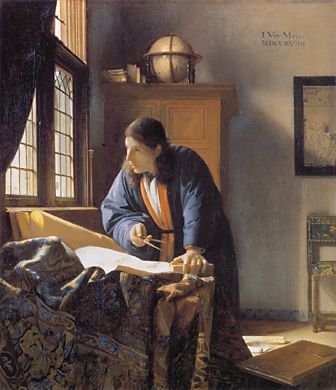
I’m still left with the question of whether imagination by itself can ever be enough. When I read a poem like “The Geographer”—“They are burning the flood fields—such a hissing, hissing, / like a landscape of toads”—it seems it could be. The poem imagines what the geographer in Vermeer’s painting sees outside his window, and also imagines how what he sees is colored by his heart disease: “When the flood waters crested, dark coffins / bobbed down through the cane stalks like blunt pirogues.” Sometimes imagination is wedded to such a passionate compassion that there’s nothing more to ask of a poem.

Wednesday, April 25, 2007

Never rains, it pours

Two weeks since I posted last, and nobody else, not even Robert, seems to post here lately. I've had a tremendous amount of work--on top of the ongoing problematic situation about which I can't post. On top of this, we had houseguests, people I really love, but still …. And John was away for days during their visit. I tried to be calm and forgiving about this, but it's not really my nature. Still, he stayed up last night with me as I worked until 1:30 a.m., so okay.

I got my copies of FIELD with my poem in it. I got it, but I haven't had the courage to actually look at it yet. I am, at least temporarily, changing the name of the manuscript, BTW, from Demimonde to Conjugated Visits. Maybe it will have better luck.

Gotta run!

Wednesday, April 11, 2007

Another garden post


Nothing actually poetry related to post here, though my NER came today, which is nice. All the poetry journals John got me for Xmas presents are coming home to roost, which is a good thing. I need to find time to read them before turning in at night, though. If I plan to read them in bed, I usually don't get very far before falling asleep. And I'm waiting for my FIELD to arrive -- with my poem in it, not that the world will change one bit, but it will be nice.

Today I am savoring being home and working in my office, overlooking our gorgeous garden that is sparkling in the sun after the morning's spring rain. I shouldn't say sun too loudly, or it will bring on the fog and the wind, no doubt. But you can't imagine how lovely it is to be here, especially with the very real possibility of not being here much longer. How I wish there were some way I could just work at home, editing or writing as the mood takes me. But it is not going to happen, and the stress of not having the wherewithal to pay the bills isn't fun either. I keep waiting for John to get that Great Big Contract that will lift us out of debt into the style to which we want to become accustomed, that of two not-so-young artists working at their art. I keep waiting to win the lottery too.

The Cecille Bruner rose bush has started to bloom. By May it will be covered with thousands of small, intensely pink, perfectly formed roses, no bigger than a quarter. The Douglas iris, the red Peruvian lilies, the periwinkle, the little pink and white daisy-looking things whose names I forgot--all these and more are blooming, and the Japanese maple, new green and tinged with red moves in the breeze like a creature breathing.

~~~~~~~~~~~~~~~~~~~~~~~~~~~~~~~~~~~~
Greta likes her walks. And she likes nothing better on her walks than a well-kept lawn. Greta is a connoiseur of lawns. And she really shows her pleasure.

Thursday, April 05, 2007

Spring Break!

Yes, almost two whole weeks before I have to deal with it again. Delightful! That is all I will allow myself to say. (And actually, there are some loose ends to tie up, despite my freedom.)

I'm still waiting on some editing work that is supposed to come in today. Meanwhile, I've been revising my Picasso women poems, which I may send out as a chapbook. It's a very rich repast -- revising one poem after another -- so writing this post is sort of cleansing my palate. (I've revised 6 out of the 20 pages, the first four women, since Tuesday.)

I find that time is the best tool for revision. If I can put something away wholly for six months to a year, I can hear it with new ears and see it with new eyes.

The good news is I think it isn't bad. I've been pretty discouraged lately re po biz. Look, I'm not going to be the next new new thing. But I can write. Still.

Tying in this post with Robert's post that came before it and with the mini-brouhaha that has arisen about David Sedaris's making a story out of his life, I have always asserted that there's a very porous membrane separating truth and fiction (or truth and poetry, as in my Picasso poems). Of course I'm putting words in these women's mouths and what "actually" happened was different, but so is any recounting of one's life or another's. As soon as you write it, you put a frame around it, much as a photographer takes what he sees and frames it. This idea was the "subject" of my Master's thesis, way back in the last century.

Tuesday, March 27, 2007

This Actually Happened!

Slate has an interesting dialogue this week between poets Dan Chiasson and Meghan O’Rourke on autobiography and poetry, as part of a “Memoir Week.” What most interests me is not really the issue of autobiography and memoir, but what Dan Chiasson calls “the reality guarantee”:

But what about when writers play to the readerly preference for facts? Here we are on riskier grounds. “This actually happened!” writes Allen Ginsberg at the end of “Howl,” of a story so fantastical—a man jumps off the Brooklyn Bridge and walks away unharmed—that we might otherwise categorize it as “surreal.” But if we DID categorize it that way, it would be just another one of the marvelous, incandescent, surreal details in “Howl”—nice but forgettable. Because Ginsberg underwrites it with this remarkable assertion—”this actually happened”—(and because, importantly, he says that only ONCE in the whole poem) the bridge-jumping episode becomes, for me, the most powerful thing in the poem. It’s as though the curtain parted and the “real” Ginsberg, suddenly playing by the ordinary rules of “factual” depiction, addressed the “real” reader.

This move—let’s call it the “reality guarantee”—needn’t be so explicit as saying, “This actually happened.” There are other ways to cue a documentary response in readers, other terms of the documentary contract. The visually ingenious detail, so real it feels like a snapshot (the doilies, for example, in Elizabeth Bishop’s “Filling Station”) or the affective detail so open and attractive as to feel “artless” (as when Frank O’Hara says “fun” in the first line of “Having a Coke with You”). And there are acts of strong intimacy, like Hopkins when he tells God, “I am gall, I am heartburn,” or like Herbert’s when (in “The Flower”) he exclaims, “Who would have thought my shriveled heart / Could have recovered greenness.” Or take it further back: you mention Sappho. When Sappho describes turning “greener than grass” at the sight of her beloved in the presence of a man, or when the anonymous poets of the Greek Anthology proclaim across the millennia, “I press my lips to yours.” These moments read as “real,” no matter what cultural or historical distance intervenes, and I must say, these moments are more or less what I look for in poems.

Thursday, March 22, 2007

Whine Glass--Half Empty

I know it's because I had a lousy night -- awoken at least four times by my own internals, by the cat outside, by the tightening and tightening of the chains of our quotidian constraints -- but I'm having an awful hard time doing what I need to do today. I don't need anyone to remind me that I am in the larger existential sense lucky. And I don't really think there's any cosmic force weighing things, allowing this much angst for that much fortune. But I'm worried. I'm worried that at this stage of life we haven't figured out how to play the game well enough to win more than we lose. I'm worried because my strength is failing me. It's not even that I don't want to fight any more, but that the wear and tear is killing me. Three steps up and two down, two steps up and three down. How long can one bear this?

I'll stop, I promise. The day is lovely. Maybe later on today I will be able to nap and probably the world will then improve. Maybe there will be a letter, a phone call, an email that will help me see it.